How to Measure for a Truck Bed Cover
Measuring for a truck bed cover is essential to ensure a secure, watertight fit that protects your cargo and enhances your truck’s appearance. With the right tools and a few simple steps, you can avoid costly mistakes and enjoy a hassle-free installation. Whether you’re installing a hard or soft cover, accurate measurements are the foundation of a long-lasting solution.
# How to Measure for a Truck Bed Cover
So, you’ve decided it’s time to upgrade your truck with a bed cover. Maybe you’re tired of rain soaking into your gear, or perhaps you just want to give your truck a sleek, finished look. Either way, a truck bed cover is a smart investment—but before you rush out to buy one, there’s something crucial you need to do: measure your truck bed properly.
You might think, “How hard can it be? Just measure the inside of the bed,” but getting it right makes all the difference. An ill-fitting cover won’t seal well, could damage your truck’s bed rails, or worse—fall off while driving. That’s why taking the time to measure correctly isn’t just helpful; it’s essential. In this guide, we’ll walk you through every step, from gathering the right tools to interpreting your measurements like a pro. By the end, you’ll know exactly how to measure for a truck bed cover so you can shop with confidence and install with ease.
## Why Accurate Measurements Matter
Before diving into the how-to, let’s talk about the why. A truck bed cover is more than just a lid—it’s a protective barrier against dirt, weather, and theft. But if it’s not fitted properly, it fails at every job. A loose cover may flap in the wind, reducing fuel efficiency and creating noise. A tight fit without room for expansion due to temperature changes can warp the cover or damage your truck bed. And if you skip measuring and guess the size, you risk returning an expensive product or spending extra on professional installation.
Moreover, many modern bed covers are custom-fitted to your truck model. This means they’re designed to work seamlessly with your bed’s contours, rails, and tailgate. Getting the dimensions right ensures compatibility with latches, seals, and mounting hardware. Think of it like buying shoes—you wouldn’t wear size 9 if your foot is size 8. The same logic applies to truck bed covers. So, let’s get started.
## Step 1: Gather Your Tools
Before you even touch your truck, make sure you have the right tools. You don’t need anything fancy, but accuracy starts with quality equipment.
– **Flexible measuring tape:** This is non-negotiable. A rigid ruler won’t bend around curves or corners.
– **Level:** To check if your truck bed is perfectly flat—especially important for hard covers.
– **Notepad and pen:** Jot down measurements as you go.
– **Flashlight:** Helps you see into tight spaces, especially near tailgates and bed sides.
– **Tape measure app (optional):** If you prefer digital tools, many smartphones have built-in measuring apps.
Having everything ready prevents interruptions and keeps you focused. Also, measure during daylight hours when visibility is best.
## Step 2: Know Your Truck’s Specifications
Every truck bed is different, and even two trucks from the same model year can vary slightly depending on trim level or modifications. Start by identifying:
– **Make, model, and year**
– **Bed size:** Standard short bed, long bed, or crew cab?
– **Bed type:** Regular, extended, or dual rear wheels?
For example, a 2020 Ford F-150 with a standard 6.5-foot bed will have different requirements than a 2018 Toyota Tacoma with a 5-foot bed. Some manufacturers list these details on the driver’s side door jamb sticker. Once you have this info, cross-reference it with the bed cover manufacturer’s fitment guide. Most reputable brands provide a lookup tool on their website where you enter your truck details and get recommended cover sizes.
## Step 3: Measure the Bed Length
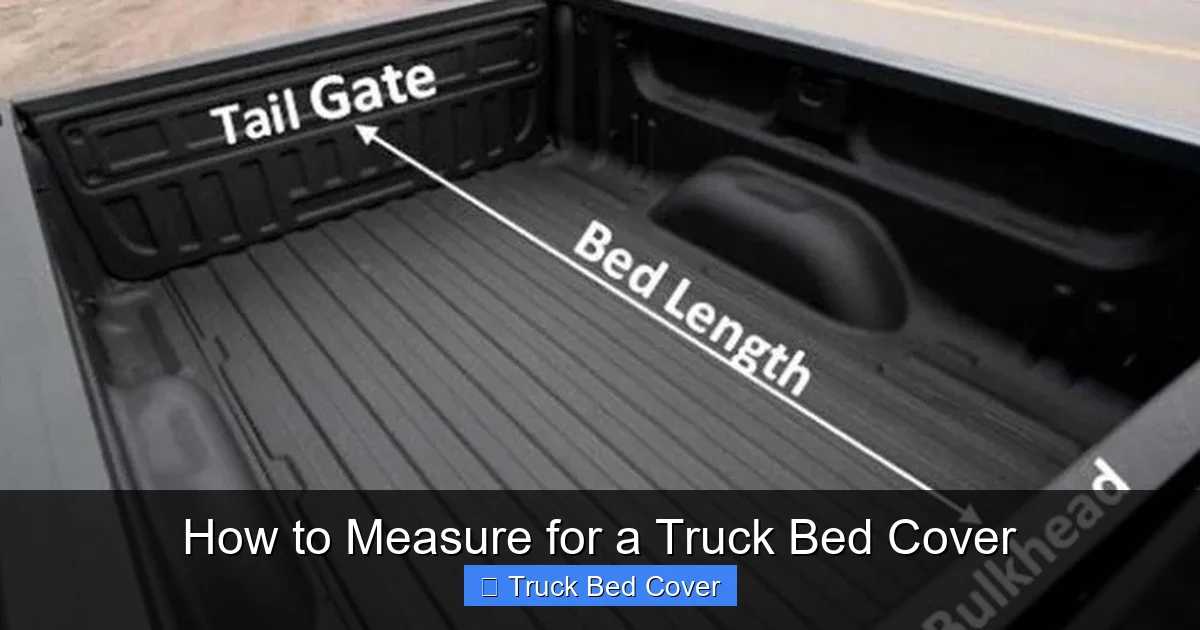
The length of your truck bed is usually the easiest dimension to measure. It’s the distance from the front bulkhead (the wall behind the cab) to the tailgate.
### How to Measure:
1. Open the tailgate fully.
2. Place the end of your measuring tape flush against the inside edge of the bulkhead.
3. Extend the tape straight back along the floor to the inside edge of the tailgate latch.
4. Record the number in inches or centimeters.
💡 **Tip:** Don’t measure to the outside of the tailgate—always use the inside edge. Also, make sure the bed is empty and flat. Loaded items or uneven surfaces can throw off your reading.
Example: If your tape reads 78 inches, you’re looking at a standard 6-foot bed (since 72 inches = 6 feet). Many roll-up covers come in sizes like 5.5′, 6′, 6.5′, and 8′. So, a 78-inch bed would typically take a 6.5′ cover.
## Step 4: Measure the Bed Width
Width is trickier because it varies along the length of the bed—especially if your truck has curved sides or flared wheel wells. For accuracy, take three measurements:
1. **Front width:** At the very front, near the bulkhead.
2. **Middle width:** In the center of the bed.
3. **Rear width:** Near the tailgate.
Then, use the smallest of these numbers as your official width. Why? Because most covers are sized to fit the narrowest point. If you use the widest measurement, the cover won’t sit flush at the ends.
### How to Measure:
– Use your flexible tape to wrap around the inside perimeter at each point.
– Keep the tape snug but not stretched.
– Note all three values.
Example: Front = 54″, Middle = 56″, Rear = 53″. Your bed width is 53″ because that’s the limiting factor.
Most soft covers come in widths like 54″, 56″, or 58″. So, a 53″ bed would require a 54″ cover to allow for overlap and proper sealing.
## Step 5: Measure Bed Height (for Hard Covers)
Unlike soft covers, hard covers—like fiberglass caps or tri-fold models—require clearance above the bed. This is called “rack clearance” or “overbed height.”
### How to Measure:
1. Remove any aftermarket racks or accessories.
2. Measure vertically from the top edge of the bed rail to the highest point above (usually the roofline).
3. Add a small buffer—about 1–2 inches—to ensure the cover doesn’t rub.
Why? Hard covers sit higher than soft ones and need space to operate without interference.
Example: If your bed rail is 14″ high and your roof starts another 12″ above that, your total overbed height is 26″. A standard tri-fold cover might require 24–28″ clearance, so you’re good to go.
## Step 6: Account for Accessories and Modifications
Your truck might have extras that affect how a cover fits:
– **Bed rails or tonneau rails:** These run along the sides and must align with the cover’s mounting brackets.
– **Toolboxes:** A locked box in the bed blocks full coverage and may require a cutout.
– **Tailgate locks:** Some covers integrate with the tailgate latch; others don’t.
– **Spray-in bed liners:** These alter the bed’s interior dimensions and may require a custom-fit cover.
Always mention these details when purchasing. Many companies offer modified versions for trucks with liners or toolboxes.
## Step 7: Choose the Right Cover Style
Different cover types have unique measurement needs:
| Cover Type | Key Measurement Consideration |
|——————|——————————-|
| Roll-Up | Width and length only |
| Tri-Fold | Length, width, and overbed height |
| Retractable | Requires electric power source; measures length and width |
| Hard Folding | Same as tri-fold |
| One-Piece Fiberglass | Full-length bed; needs overbed clearance |
For instance, a retractable cover needs access to your truck’s 12V power outlet. A roll-up cover doesn’t care about height but must clear the cab’s rear window.
## Step 8: Double-Check Everything
Mistakes happen—even pros make them. Before finalizing your order:
– Re-measure everything.
– Compare your numbers with the manufacturer’s fitment chart.
– Ask a friend to verify if possible.
– Read customer reviews for similar trucks—sometimes real users share exact measurements that worked for them.
If you’re unsure, call the manufacturer’s customer service. Most are happy to help confirm sizing.
## Common Mistakes to Avoid
Even experienced truck owners slip up. Here are the top errors:
– Measuring to the outside of the tailgate or bed rails.
– Ignoring seasonal temperature changes—materials expand and contract.
– Assuming all “6-foot beds” are identical.
– Not removing racks or liners before measuring.
– Using outdated truck information.
Avoiding these pitfalls saves time, money, and frustration.
## Final Tips for Success
– **Measure twice, cut once**—well, measure three times!
– **Take photos** of your setup before disassembly—great for reference.
– **Consider professional measurement services** if you’re still uncertain.
– **Buy from reputable brands** that offer fitment guarantees.
Remember: a well-chosen, properly measured cover lasts longer, performs better, and looks great.
In conclusion, measuring for a truck bed cover isn’t rocket science—it’s about attention to detail and preparation. By following this guide, you’ll ensure your new cover fits like a glove, protects your belongings, and boosts your truck’s value. So grab that tape, clear the bed, and get measuring. Your future self will thank you.
Key Takeaways
- Use the correct measuring tools: A flexible measuring tape and level are essential for accurate results.
- Measure multiple times: Always double-check your measurements to avoid ordering the wrong size.
- Consider bed length, width, and height: These three dimensions determine the type of cover compatible with your truck.
- Account for accessories: Tailgates, bed rails, and toolboxes can affect clearance and installation.
- Know your truck model and year: Some covers are model-specific for a precise fit.
- Choose the right cover style: Different covers (roll-up, folding, retractable) have unique measurement requirements.
- Consult manufacturer guidelines: Always refer to the cover’s instructions for specific measurement tips.
Quick Answers to Common Questions
What tools do I need to measure my truck bed?
A flexible measuring tape, level, notepad, pen, and flashlight are the essentials. Optional but helpful: a smartphone with a measuring app.
Can I measure my bed with a spray-in liner?
No—remove the liner first. Liners alter the bed’s internal dimensions and can cause a poor fit. Most covers require bare metal or drop-in liner measurements.
How do I know if my cover will work with a toolbox?
Check the manufacturer’s website or contact support. Some covers accommodate toolboxes with cutouts; others aren’t compatible. Don’t assume—confirm!
Is it okay to round up to the next size?
Yes, but only slightly. Adding 1–2 inches gives room for overlap and movement. Don’t go too big, or the cover may sag or interfere with the tailgate.
What if my measurements don’t match any standard sizes?
Look for custom-fit options or contact the manufacturer. Some brands offer made-to-order covers for unique configurations.
Frequently Asked Questions
Do I need to remove my bed rails to install a cover?
No, most modern covers are designed to work with existing bed rails. However, some heavy-duty models may require removal for installation. Always check the product manual.
Can I install a cover over a camper shell?
Generally no. A camper shell replaces the entire bed structure. You’d need a cover specifically made for camper shells, which are rare and often custom-ordered.
How does temperature affect measurements?
Extreme heat or cold causes materials to expand or contract. Install covers in moderate temperatures when possible. Allow extra space if installing in winter.
Are universal covers a good option?
They’re cheaper but rarely fit well. Universal covers often sag, leak, or damage your truck. Model-specific covers are worth the investment for durability and performance.
Can I return a cover if it doesn’t fit?
Most retailers accept returns within 30 days if the cover is unused and in original packaging. Check the return policy before purchasing. Some manufacturers offer exchange programs.
What’s the difference between a soft and hard cover in terms of measurement?
Soft covers only need length and width. Hard covers also require overbed height measurement because they sit higher and must clear racks or the cab roof.